

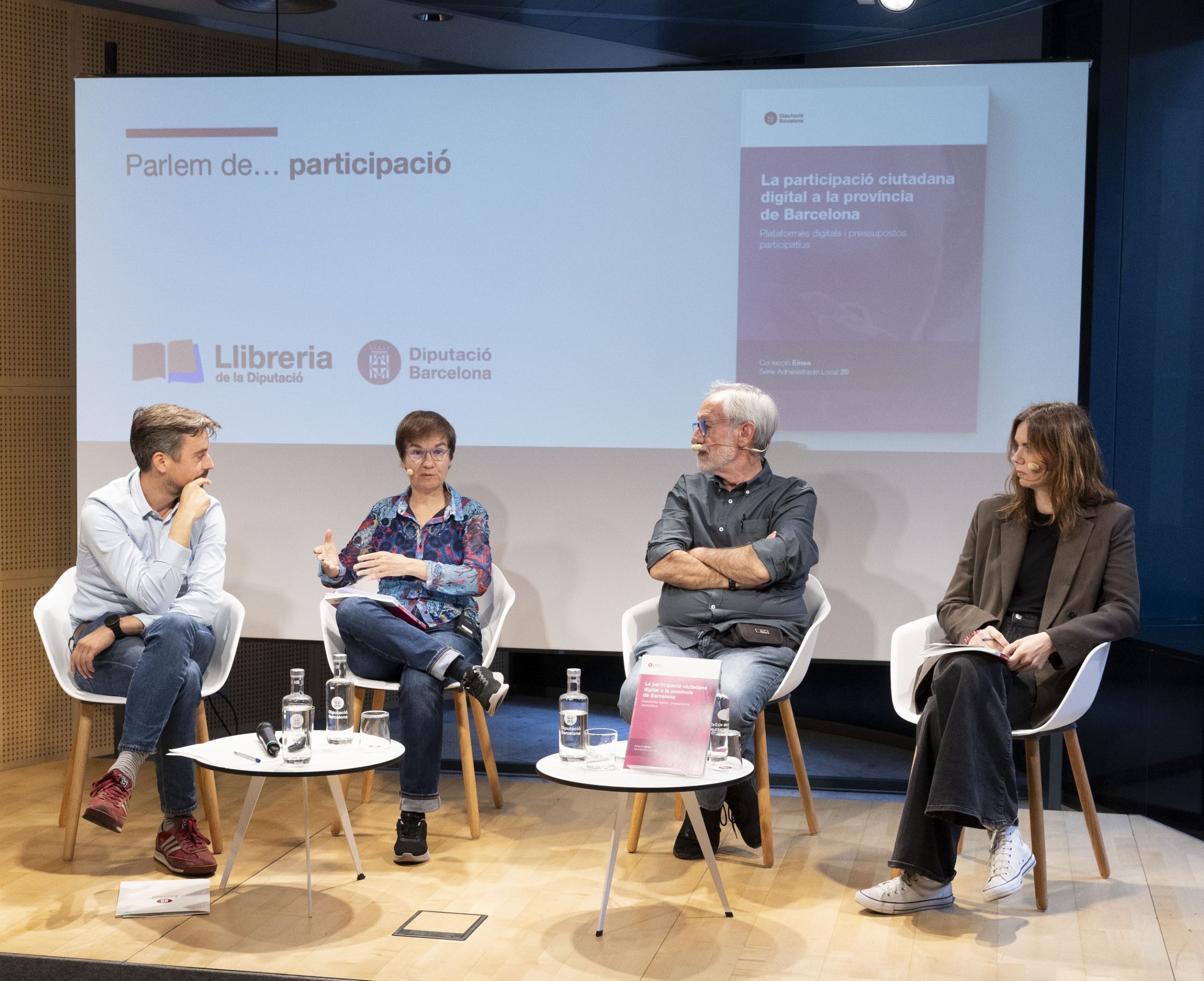
Participation in the conference organized by the Barcelona Provincial Council (Diputació de Barcelona) on May 5, 2026, regarding participatory budgeting through digital platforms in the province of Barcelona. During the event, the Council-commissioned report was presented: La participació ciutadana digital a la província de Barcelona. Plataformes digitals i pressupostos participatius, by Noel Sotelo Fernández and Marc Martí-Costa from the Institut Metròpoli.
The event was hosted by the Deputy for Participation of the DIBA, Marc Serra Solé, and Rosa Borge took part in the round table discussion following the presentation of the report. The panel—which also included Xavier Riu (activist from the Eixample Neighborhood Association) and Esther Rufas (Participation officer and administrator of Participa311 in Begues)—debated to what extent participatory budgeting serves as a tool for social justice.
Rosa Borge highlighted 4 risks and 4 shields identified in studies of Catalan municipalities conducted by the UOC research groups CNSC and GADE:
- ❌ The abandonment of participatory budgeting is at risk during a change of the ruling party, ✅ but this is mitigated by elements such as having formal regulations, previous editions already held, and an active organized civil society that pressures for the continuity of the process.
- ❌ Difficulties in achieving social justice effects in the most frequent models of participatory budgeting, ✅ but designs focused on inclusion and territorial and socioeconomic redistribution also exist.
- ❌ The substitution of face-to-face activities and spaces with exclusively online ones in some municipalities, ✅ but the maintenance of hybrid models and the awareness of the need for in-person deliberation in many other municipalities.
- ❌ The risk of polarization due to coordinated action by organized online groups, ✅ but the existence of hybrid mechanisms to mitigate them, such as online collaborative moderation, strong verification, monitoring by administrators, and the in-person defense and debate of projects.
In her intervention, she explained that in the journey of participatory budgeting from Brazil and Latin America in the late 80s to Europe, the redistributive effect toward the most disadvantaged social sectors has been lost. Therefore, these processes must be explicitly designed with a redistributive and inclusive intent, allocating a significant portion of resources to the most vulnerable neighborhoods and groups. This allows decisions to be made on social and cultural projects and services, rather than solely on urban investments. However, it is not just a matter of process design; it requires a diagnosis of the municipality’s needs and problems, fostering the involvement of disadvantaged sectors through, for example, the co-production and civic management of proposals.
Currently, participatory budgeting has achieved a high degree of institutionalization but remains very vulnerable to changes in government. For participatory budgets to stop depending on the current administration and become a structural policy, they must take root in both society and local institutions so that eliminating them causes a legitimacy crisis for the local government. Participatory budgeting will be sustained over time if legal frameworks (rules) coincide with citizen pressure and innovation from below (practices) and a persuasive, hegemonic discourse in their favor (narratives). In these rooted ecosystems, eliminating the participatory process generates such high political and social tension—and such a significant reputational cost for the new mayor—that they will prefer to maintain it.
View news about the event: News and post.
Watch the recorded event on YouTube: