
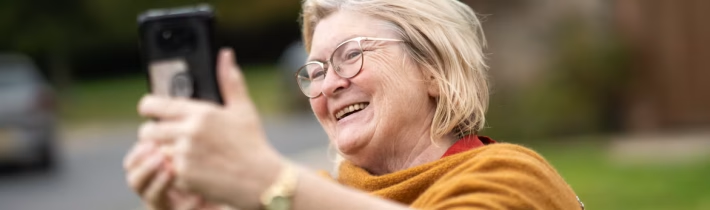
The article “Media Transitions in Later Life: A Seven-Year Longitudinal Study of Digital Pioneers in Romania”, co-authored by CNSC researcher Mireia Fernández-Ardèvol in collaboration with Loredana Ivan and Francisca Morey Cortès, has been published.
The article analyses how the media practices of older adults evolve over time and examines which social and personal factors can accelerate or modify these processes. In particular, the study pays attention to the impact of the COVID-19 pandemic and two frequent life transitions during older age: retirement and widowhood.
The research is based on a seven-year longitudinal design. A total of 252 internet users aged 60 and over residing in Romania participated in four waves of data collection, conducted in 2016, 2018, 2020, and 2023. At the start of the study, these individuals could be considered digital pioneers within their generation, as they were already using the internet and other digital media at a relatively early stage of its adoption among the country’s older population.
The results show that media transitions during older age are gradual and sustained processes, rather than changes that happen overnight. Whilst the time spent on traditional media remained relatively stable during the analysed period, the use of digital media increased, especially in the field of interpersonal communication.
This growth was particularly visible in the use of digital tools designed to maintain social relationships and communicate with others. Following the boost brought about by the COVID-19 pandemic lockdowns, these practices stabilised at levels higher than those recorded prior to 2020. The pandemic would have acted, therefore, as an accelerating factor in a transition that was already underway, without causing a complete break with previous media practices.
The study also identifies displacement processes between certain traditional and digital media. However, this displacement does not occur uniformly. Interpersonal digital communication media do not simply replace earlier forms of communication, but are progressively integrated into the daily lives of older adults, expanding their possibilities for interaction and socialisation.
In contrast, retirement and widowhood showed no significant influence on the observed media transformations. This result indicates that wide-reaching social events, such as the pandemic, can have a greater impact on digital practices than certain personal transitions linked to the life course.
The article highlights the importance of studying media use through longitudinal research. Single-point analyses may fail to detect displacement or transformation processes that only become visible when practices are observed over several years and different types of media are carefully distinguished.
The results also challenge the stereotyped notion that ageing necessarily leads to passivity or the rejection of new technologies. On the contrary, the increase in time spent on digital activities between 2016 and 2023 shows that older adults actively participate in hyper-digitalisation processes and adapt their media practices to social and technological transformations.
The article is available at: https://doi.org/10.21018/rjcpr.2026.1.893
Photo: Centre for Ageing Better (Unsplash).