
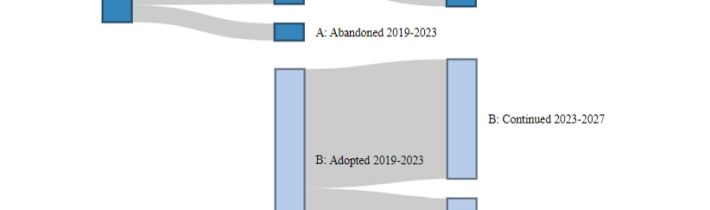
Catalonia has experienced a new wave of participatory budgeting at the municipal level over the last decade. This type of democratic innovation has gained weight as a practice to promote more participatory governance, especially in a context of general discredit of political institutions. Despite this, participatory budgeting has experienced an uneven implementation: while in some municipalities the practice has become consolidated over time, in others it has had a relatively short life. Why do these very different trajectories occur?
We have recently published Between Resilience and Abandonment: Political Factors Determining Participatory Budgeting Through Digital Participatory Platforms, where we analyze the political factors that explain their continuity or abandonment. The study was based on the monitoring of 90 Catalan municipalities where participatory budgeting has been carried out through the Decidim platform between 2016 and 2025. The database can be consulted openly in the following repository. The study is inspired by the quantitative analyses carried out in Brazil, a pioneering country in participatory budgeting, where the existence of a census of experiences has allowed for a detailed study of its diffusion, rise, and decline processes.
The results of our analyses show that the continuity or abandonment of participatory budgeting is conditioned by electoral cycles. Specifically, we have observed that participatory budgets show a higher probability of declining when there is a change in the ruling party, especially if the mayoralty falls to a centrist party. However, some factors contribute to protecting the continuity of participatory budgets. For example, a greater institutionalization of participation —in terms of a greater accumulation of past experiences or the existence of citizen participation regulations— helps to increase the probability of continuity. Likewise, municipalities that have a more solid participatory culture also show a higher probability of continuity for participatory budgeting.
Thus, the study highlights the existing connection between democratic innovations and the balance of municipal political forces. While the local world is often a favourable ground for democratic experimentation, these initiatives are frequently promoted by the institutions themselves and are not exempt from the political calculation of the government in power. In this sense, the political context provides relevant information to better understand the origin and development of innovations such as participatory budgeting and, ultimately, their probability of survival or death.
Peiruza-Parga, J., Balcells, J., Borge, R., & Padró-Solanet, A. (2026). Between resilience and abandonment: Political factors determining participatory budgeting through digital participatory platforms. Media and Communication, 14. https://doi.org/10.17645/mac.11507