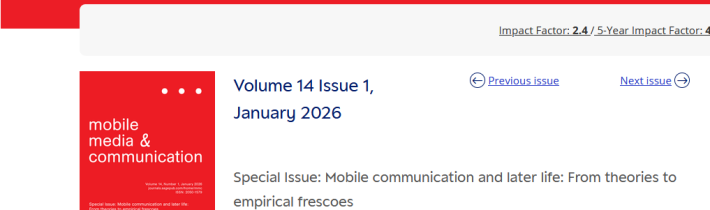
The journal Mobile Media & Communication has published, in volume 14, issue 1 of 2026, a special issue titled “Mobile communication and later life: From theories to empirical frescoes”, co-edited by Mireia Fernández-Ardèvol, researcher at the CNSC (TRÀNSIC-UOC) group, and Sakari Taipale.
Published by SAGE, Mobile Media & Communication is one of the leading journals in the field of mobile media and communication. It is indexed as a Q1 journal in Communication and serves as an international, interdisciplinary forum for cutting-edge research on mobile media, mobility and communication practices.
The special issue brings together 12 research articles that examine the role of mobile communication in older people’s lives from diverse theoretical, empirical and methodological perspectives. It seeks to revisit dominant ways of thinking about the relationship between ageing, mobile technologies and everyday life, challenging representations of older adults as passive, lagging behind or disconnected from technological innovation.
In the editorial, “Mobile communication and later life: From theories to empirical frescoes”, Mireia Fernández-Ardèvol and Sakari Taipale argue that mobile communication has historically been associated with youth, innovation and a technological culture shaped by youthful and masculinised imaginaries. However, two major contemporary transformations — population ageing and the digitalisation of everyday life — make it necessary to rethink this association.
The articles included in the special issue show that mobile communication occupies a central place in the everyday lives of many older people across different contexts around the world, from Finland to Australia, Italy, India, the United States and China. This presence takes multiple forms: active and independent use of devices and platforms, shared use with family members, friends or support networks, and even deliberate forms of non-use.
One of the main contributions of the special issue is to show that mobile communication cannot be understood as an isolated practice. In the everyday lives of older people, mobile phones, social media, video calls, online information seeking, face-to-face interactions and other digital and analogue technologies are combined in complex ways. For this reason, the special issue proposes analysing mobile communication as part of a broader assemblage of social relations, material environments, life trajectories and contexts of inequality.
Among the topics addressed in the special issue are forms of digital agency in later life, experiences of digital inclusion and exclusion, narratives of ageing on platforms such as TikTok and Douyin, sociotechnical inequalities, practices of use and non-use of mobile technologies, and methodological innovations for researching mobile communication with older adults.
Overall, the special issue makes a highly relevant contribution to communication studies from the perspective of ageing studies. It brings ageing to the centre of mobile communication research and shows that later life is not a marginal or secondary site for understanding digital culture, but a key vantage point from which to rethink how mobile technologies are adopted, adapted, shared, resisted or abandoned. Rather than presenting older people as a “problem” to be solved through digital inclusion, the special issue approaches them as active, critical, selective and imaginative users of mobile technologies. Their practices offer valuable insights for understanding both the present and the future of digital communication.
The introduction to the special issue, “Mobile communication and later life: From theories to empirical frescoes”, by Mireia Fernández-Ardèvol and Sakari Taipale, is available in open access at: https://doi.org/10.1177/20501579251398570